- The 5 most recent posts are displayed on the main page.
- A permanent link list, entitled "Pertinent & Impertinent" is always visible on the sidebar of the course website, containing direct links to crucial information.
- Also on the sidebar, always visible, is the "Blog Archive" displaying direct links to all posts on the course website.
- The "Blog Archive" has sections for years 2009 and 2007. Our course links are under the 2009 section. The 2007 archive is for a previous iteration of the course which may, or may not, be interesting for you.
- An "Older Posts" hotlink is always visible at the bottom of the main page which displays the next 5 most recent posts.
- Certain PowerPoint lecture slides are occasionally posted on the course website.
Monday, September 7, 2009
Course Website FAQ
Here are FAQ about the course website.


Course Outline
ENGLISH 101W J1.00 Harbour Centre INTRODUCTION TO FICTION
(Writing Intensive)
Instructor: S. Ogden FALL 2009
THE FICTIONS OF THE SEXES: WOMEN’S & MEN’S NOVELS
It is contentious to claim that there are novels for women and other novels for men, notwithstanding publishing and marketing of genre labels such as ‘chick-lit’ and ‘lad-lit’. What is not disputed, however, is fiction’s characterisation of maleness and femaleness. In this course we will read popular and important twentieth-century novels which explicitly configure a male or a female protagonist and which each became notorious for their implied valuation of either the masculine or the feminine. To help frame our understanding of the fiction, we will consider the texts in light of authoritative statements of sexual identity—from Charles Darwin and Sigmund Freud for instance. We will also bring in examples from our own experiences of portrayals of men and women in mass culture. The design of the course uses this particular type of literature as a practical means to learn how to read, analyse and appreciate fiction broadly—part of which involves improving the enjoyable practice of writing.
REQUIRED TEXTS:
Montgomery, L.M. Emily of New Moon N.C.L
Amis, Kingsley Lucky Jim Oxford UP
Gibbons, Stella Cold Comfort Farm Penguin
Burgess, Anthony A Clockwork Orange Oxford UP
Fielding, Helen Bridget Jones's Diary Penguin
Hornby, Nick High Fidelity Riverhead
COURSE REQUIREMENTS:
10% Productive Participation
15% Three Seminar Writing Presentations
20% Semester Group Culture Project
20% Mid-Term Essay (approx. 1500 words with revision)
35% Final Exam
35% Final Exam
To receive credit for this course, students must complete all requirements.
Dividing Post: 2009 from 2007
Posts above this dividing post are for the current (2009) version of the course. Posts below this dividing post are archived posts from the 2007 iteration.
Friday, April 6, 2007
More on Zero-Sum: Kitsch
I have a classfellow request to blog the kitsch I used to exemplify Zero-Sum thinking in regard to the sexes.
The first was a fridge magnet collection sold in the SFU BookStore. [Click on the image for larger view]:
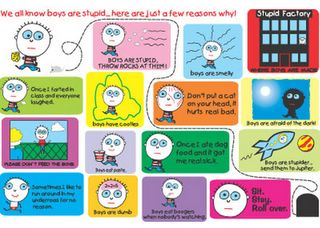
The second was a metal plate found at a garage sale entitled "The Rules" and which read as follows:
1. The Female always makes THE RULES.
2. THE RULES are subject to change without notice.
3. No Male can possibly know all THE RULES.
4. If the Female suspects the Male knows all THE RULES, she must immediately change some of THE RULES.
5. The Female is never wrong.
6. If it appears the Female is wrong, it is because of a flagrant misunderstanding caused by something the Male did or said wrong.
7. If Rule #6 applies, the Male must apologize immediately for causing the misunderstanding.
8. The Female can change her mind at any time.
9. The Male must never change his mind without the express written consent of The Female.
10. The Female has every right to be angry or upset at any time.
11. The Male must remain calm at all times, unless the Female wants him to be angry or upset.
12. The Female must, under no circumstances, let the Male know whether she wants him to be angry or upset.
13. The Male is expected to read the mind of the Female at all times.
14. At all times, what is important is what the Female meant, not what she said.
15. If the Male doesn't abide by THE RULES, it is because he can't take the heat, lacks backbone, and is a wimp.
16. If the Male, at any time, believes he is right, he must refer to Rule #5.
From among the exchanges, two stick in my mind. One is the way that The Rules -- especially Rule 15-- highlight male insecurity / performative masculinity. The other was the suggestion that if "the Female" in The Rules is changed to "God", then you have sixteen points of understanding Kafka's conception of God.
A classfellow from a previous course emailed me the following commentary.
The first was a fridge magnet collection sold in the SFU BookStore. [Click on the image for larger view]:

The second was a metal plate found at a garage sale entitled "The Rules" and which read as follows:
1. The Female always makes THE RULES.
2. THE RULES are subject to change without notice.
3. No Male can possibly know all THE RULES.
4. If the Female suspects the Male knows all THE RULES, she must immediately change some of THE RULES.
5. The Female is never wrong.
6. If it appears the Female is wrong, it is because of a flagrant misunderstanding caused by something the Male did or said wrong.
7. If Rule #6 applies, the Male must apologize immediately for causing the misunderstanding.
8. The Female can change her mind at any time.
9. The Male must never change his mind without the express written consent of The Female.
10. The Female has every right to be angry or upset at any time.
11. The Male must remain calm at all times, unless the Female wants him to be angry or upset.
12. The Female must, under no circumstances, let the Male know whether she wants him to be angry or upset.
13. The Male is expected to read the mind of the Female at all times.
14. At all times, what is important is what the Female meant, not what she said.
15. If the Male doesn't abide by THE RULES, it is because he can't take the heat, lacks backbone, and is a wimp.
16. If the Male, at any time, believes he is right, he must refer to Rule #5.
From among the exchanges, two stick in my mind. One is the way that The Rules -- especially Rule 15-- highlight male insecurity / performative masculinity. The other was the suggestion that if "the Female" in The Rules is changed to "God", then you have sixteen points of understanding Kafka's conception of God.
A classfellow from a previous course emailed me the following commentary.
My personal response to popular examples of "kitsch" such as 'The Rules' and the "boys are stupid" magnets is very unsettling. More than the objects themselves, what I find especially disturbing is that these sorts of blatant exploitations of gender stereotypes are intended to be funny. 'The Rules' example in particular operates on exactly the same logic that allowed women to be oppressed for centuries, yet a simple gender reversal apparently makes it appropriate to laugh at today. I think any sort of humor that operates on the principle that a certain sex is contemptible because they necessarily possess some undesirable trait is unacceptable. It is offensive not only to the targeted gender but any person who doesn't feel like they fit the prescribed role for their sex. For instance, I feel insulted by the insinuation that the female is always the pushy, overbearing partner in a relationship, and while most children experience a certain amount of antagonism towards the opposite gender at some point, I certainly don't see how it's appropriate to encourage them to deal with it by throwing rocks. Despite all the intellectualizing university students do about gender theory and social conditioning, the existence of humor like this makes me question whether sexism hasn't simply been institutionalized.
Zero-Sum & the Sexes
 A classfellow sends along this example of zero-sum thinking, on her Starbucks Coffee cup, in the context of relationships:
The most relevant piece of advice I received regarding marriage: You can only be as happy as the least happy person in the house, and two bathrooms are mandatory.
[Nb: This is a variation on the image displayed here.]
Subscribe to:
Posts (Atom)
